Hotline
+86-15822123834
Hotline
+86-15822123834Application of Dry Mist Humidification in Textile
The textile industry is an important traditional industry in China, and its employment population exceeds 15 million. The population related to the cultivation, production and processing of its supporting raw materials exceeds 0.1 billion, and it occupies a very important position in social employment, economic growth and export earnings. In 2004, the total output value of China's textile industry reached 2640 billion billion yuan, of which exports reached the US dollar 97.4 billion, accounting for 1/5 of the world's total. China has deservedly become the first of the world's textile powers. Since China's accession to the WTO, China's textile industry has developed rapidly after undergoing more intense competition and more developed market tests. From the perspective of large and medium-sized textile enterprises, the number of enterprises soared from 21000 in 2001 to 29000 in 2004, an increase of 38%. Sales increased by 78% from 866.3 billion yuan to 1548 billion yuan. The number of employees also increased from 7.63 million to 8.946 million. After entering 2005, due to the cancellation of textile quotas, the textile industry has entered a post-quota era. This is both an opportunity and a challenge for the majority of textile enterprises. It should be noted that the world's textile and clothing production surplus, the industry profit is very small, in the case of quota cancellation and weak world economic growth, and at the same time by the double squeeze of developed and developing countries, many textile enterprises in China will face the era of meager profits. Moreover, due to the shortage of energy and electricity, enterprises are under-operating and even have to cancel orders. Therefore, as far as possible to improve labor productivity, improve product quality, reduce scrap rate and save energy, has become an important way for many textile enterprises to reduce costs. Practice has proved that the scientific use of good air conditions can effectively achieve the above goals.
Air temperature, humidity, flow velocity, dust concentration and freshness are the five basic components of air conditions. They are closely related to production conditions, efficiency, process, product quality and human health. Among them, humidity is an important factor affecting the quality of the air environment, and the relative humidity in the air will have a corresponding impact on people or things in the environment. Studies have found that humidity is the main factor that constitutes air cleanliness and product durability, which affects product quality, work efficiency, human health and comfort, and sometimes it may be a decisive factor. In view of the above situation, textile enterprises have long used many methods to improve the relative humidity of the air in order to achieve the best environment for production. From the early drenching water, to the later air conditioning humidification, and then to the current industrial humidifier humidification, many new technologies emerge in endlessly, which play a decisive role in the scientific modernization of textile and clothing production. The humidity of the textile industry requires 50%-85% RH. The specific humidity of different processes is shown in the attachment "The relationship between textile process and relative humidity".
Take textile fibers for example
1. The relationship between relative humidity and moisture regain
The relative humidity of the air is different, and the moisture regain of the fiber is also different. As can be seen from Figure 1, the relative humidity of the air increases, the moisture regain of the fiber also increases, and vice versa.
2. The relationship between relative humidity and strength
Relative humidity has a great influence on the strength of the fiber, which can increase and improve the whole column degree of long chain molecules and increase the strength. For cotton fiber, when the relative humidity is 60-70%, its strength can be increased by about 50% compared with the dry state.
3. The relationship between relative humidity and elongation
The fiber after moisture absorption, due to the increase in the distance between molecules, under the action of external force that is easy to produce relative displacement, so the elongation of the fiber increases with the rise of relative humidity. Among them, wool, silk, viscose fiber moisture absorption than cotton, hemp and other natural fibers more easily stretch, as for synthetic fibers (such as polyester) because of poor moisture absorption, so the relative humidity on the elongation of the smaller.
4. The relationship between relative humidity and softness
When the relative humidity increases, the distance between the molecules of the fiber after moisture absorption increases, so the hardness and brittleness of the fiber decreases, and the softness of the fiber is greatly improved.
5. The relationship between relative humidity and electrification
The friction between the mechanical surface and the fiber or the friction between the fibers will inevitably cause the fiber to be charged. When the fiber and the body have different charges, it will hinder the smooth progress of the fiber stretching, carding, interweaving and winding process. When there are different charges between the fibers, the fibers will not be held together, hairiness will be overgrown, resulting in warp hair, so that the weaving of broken ends and pick flowers increased, so that the fabric surface is rough and the formation of scattered strips, improve the relative humidity of the air, can reduce the specific resistance of the fibers, in order to increase the speed of charge dissipation, thereby eliminating static electricity.
Common Ways and Simple Comparison of Several Industrial Humidification
Centrifugal humidification: advantages: low cost; mature. Disadvantages: large particles, poor uniformity; waste of water. Suitable for outdoor humidification.
High-pressure humidification: Advantages: The spray particles are fine and can be used indoors. Disadvantages: Need high-pressure water pump, high water quality requirements, noise interference.
Wet film humidification: advantages: clean and no noise. Disadvantages: large volume, small amount of humidification.
Steam humidification: advantages: spray particles are small and have been gasified, isothermal humidification. Disadvantages: energy consumption is very large, can not play a cooling effect.
Ultrasonic humidification: advantages: small particles, low energy consumption, can be transported. Disadvantages: high requirements for water quality, pipeline content is easy to have water, easy to breed bacteria and cause pollution. Can't work long hours.
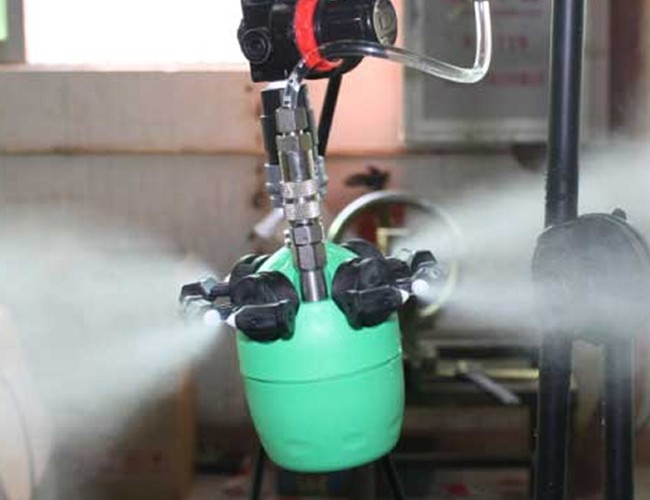
Dry fog humidification: advantages: small particles, good diffusion, cooling and humidification speed. Disadvantages: Requires pressure air supply
Application of Dry Mist Humidification in Textile
The textile industry is an important traditional industry in China, and its employment population exceeds 15 million. The population related to the cultivation, production and processing of its supporting raw materials exceeds 0.1 billion, and it occupies a very important position in social employment, economic growth and export earnings. In 2004, the total output value of China's textile industry reached 2640 billion billion yuan, of which exports reached the US dollar 97.4 billion, accounting for 1/5 of the world's total. China has deservedly become the first of the world's textile powers. Since China's accession to the WTO, China's textile industry has developed rapidly after undergoing more intense competition and more developed market tests. From the perspective of large and medium-sized textile enterprises, the number of enterprises soared from 21000 in 2001 to 29000 in 2004, an increase of 38%. Sales increased by 78% from 866.3 billion yuan to 1548 billion yuan. The number of employees also increased from 7.63 million to 8.946 million. After entering 2005, due to the cancellation of textile quotas, the textile industry has entered a post-quota era. This is both an opportunity and a challenge for the majority of textile enterprises. It should be noted that the world's textile and clothing production surplus, the industry profit is very small, in the case of quota cancellation and weak world economic growth, and at the same time by the double squeeze of developed and developing countries, many textile enterprises in China will face the era of meager profits. Moreover, due to the shortage of energy and electricity, enterprises are under-operating and even have to cancel orders. Therefore, as far as possible to improve labor productivity, improve product quality, reduce scrap rate and save energy, has become an important way for many textile enterprises to reduce costs. Practice has proved that the scientific use of good air conditions can effectively achieve the above goals.
Air temperature, humidity, flow velocity, dust concentration and freshness are the five basic components of air conditions. They are closely related to production conditions, efficiency, process, product quality and human health. Among them, humidity is an important factor affecting the quality of the air environment, and the relative humidity in the air will have a corresponding impact on people or things in the environment. Studies have found that humidity is the main factor that constitutes air cleanliness and product durability, which affects product quality, work efficiency, human health and comfort, and sometimes it may be a decisive factor. In view of the above situation, textile enterprises have long used many methods to improve the relative humidity of the air in order to achieve the best environment for production. From the early drenching water, to the later air conditioning humidification, and then to the current industrial humidifier humidification, many new technologies emerge in endlessly, which play a decisive role in the scientific modernization of textile and clothing production. The humidity of the textile industry requires 50%-85% RH. The specific humidity of different processes is shown in the attachment "The relationship between textile process and relative humidity".
Take textile fibers for example
1. The relationship between relative humidity and moisture regain
The relative humidity of the air is different, and the moisture regain of the fiber is also different. As can be seen from Figure 1, the relative humidity of the air increases, the moisture regain of the fiber also increases, and vice versa.
2. The relationship between relative humidity and strength
Relative humidity has a great influence on the strength of the fiber, which can increase and improve the whole column degree of long chain molecules and increase the strength. For cotton fiber, when the relative humidity is 60-70%, its strength can be increased by about 50% compared with the dry state.
3. The relationship between relative humidity and elongation
The fiber after moisture absorption, due to the increase in the distance between molecules, under the action of external force that is easy to produce relative displacement, so the elongation of the fiber increases with the rise of relative humidity. Among them, wool, silk, viscose fiber moisture absorption than cotton, hemp and other natural fibers more easily stretch, as for synthetic fibers (such as polyester) because of poor moisture absorption, so the relative humidity on the elongation of the smaller.
4. The relationship between relative humidity and softness
When the relative humidity increases, the distance between the molecules of the fiber after moisture absorption increases, so the hardness and brittleness of the fiber decreases, and the softness of the fiber is greatly improved.
5. The relationship between relative humidity and electrification
The friction between the mechanical surface and the fiber or the friction between the fibers will inevitably cause the fiber to be charged. When the fiber and the body have different charges, it will hinder the smooth progress of the fiber stretching, carding, interweaving and winding process. When there are different charges between the fibers, the fibers will not be held together, hairiness will be overgrown, resulting in warp hair, so that the weaving of broken ends and pick flowers increased, so that the fabric surface is rough and the formation of scattered strips, improve the relative humidity of the air, can reduce the specific resistance of the fibers, in order to increase the speed of charge dissipation, thereby eliminating static electricity.
Several common ways of industrial humidification and simple contrast centrifugal humidification: advantages: low cost; mature. Disadvantages: Large particle size and poor uniformity; wasteful of water resources. Suitable for outdoor humidification.
High-pressure humidification: Advantages: The mist particles are very fine, making it suitable for indoor use. Disadvantages: Requires a high-pressure water pump, has strict water quality requirements, and produces noise.
Wet film humidification: advantages: clean and no noise. Disadvantages: large volume, small amount of humidification.
Steam humidification: advantages: spray particles are small and have been gasified, isothermal humidification. Disadvantages: energy consumption is very large, can not play a cooling effect.
Ultrasonic humidification: advantages: small particles, low energy consumption, can be transported. Disadvantages: high requirements for water quality, pipeline content is easy to have water, easy to breed bacteria and cause pollution. Can't work long hours.
Dry fog humidification: Advantages: extremely fine droplets, excellent diffusion, and rapid cooling and humidification. Disadvantages: Requires pressure air supply.
Compared with the above several humidification schemes, only high-pressure humidification and dry mist humidification are most suitable for textile, clothing and other plant humidification.
First: the humidification area is large, the ventilation of the textile and garment factory is large, and the required humidification area is wide. Wet membrane humidification is not suitable for this large area humidification.
Second: fine droplets, evenly distributed. Centrifugal humidifier particles are not suitable for textile and garment precision humidification.
Third: cooling effect is better. Textile and clothing workshop personnel concentration, indoor temperature is higher. Need in the humidification at the same time can also play a very good cooling effect. So steam humidification is not suitable for summer and southern regions. Only suitable for the northern winter to humidify.
Fourth: humidifier can not have pollution. The mist of the ultrasonic humidifier must be transported to all parts of the workshop through the pipeline with holes, and the contents of the pipeline are easy to produce water accumulation, which can easily cause dust in the air to be adsorbed in the pipeline, breeding bacteria and mildew. When the fog spreads out again, it is easy to pollute the air. The high pressure humidification and dry fog humidification are closed, there will be no pollution sources into the pipeline. It can also produce fine particles very well. High-pressure humidification system requires a high-pressure pump to increase water pressure, so the requirements for pipelines are relatively high, and high-pressure pipes need to be used. Dry mist humidification, then the gas-driven liquid pressure is relatively small, and the safety factor is better than high-pressure humidification. Moreover, the fluidity of dry mist humidification is better than that of high pressure humidification. Now foreign large textile enterprises are using the dry mist humidification system, its advantages are:
1, less water, save water resources;
2. The nozzle is easy to disassemble, especially convenient in terms of maintenance.
3. The installation method can be wall installation, hanging installation, and movable cart. More selective installation.
4, the atomized particles are average and extremely small, with an average particle size of 7.5um.
5. Good diffusivity, using air-water mixing, flowing compressed air can bring water mist to every corner of the workshop. Make the humidity more uniform.
6, the amount and humidity of the precise, small particles. Humidity sensing is more agile and precise. The system can accurately control the temperature and humidity of the workshop.
7. Convenient control. The dry mist humidification uses low-pressure tap water and a siphon structure. You only need to switch the air source to control the spray and stop of the nozzle. 8. The multi-purpose of the system. In addition to the two functions of cooling and humidification, the dry mist system can also be used for disinfection. It only needs to dilute the harmless disinfectant in water to disinfect the workshop.